News ·
October 2026: Prices eased faster, and cars took longer to sell
Prices for the same kinds of car fell 1.6% in October, against 0.7% in September, and the median car took 40 days to sell. 40.2% of cars had their advertised price cut before they sold. Cars that sold without a cut went in 23 days, against 68 after one.
October was another month of prices easing, and a slower one for sales.
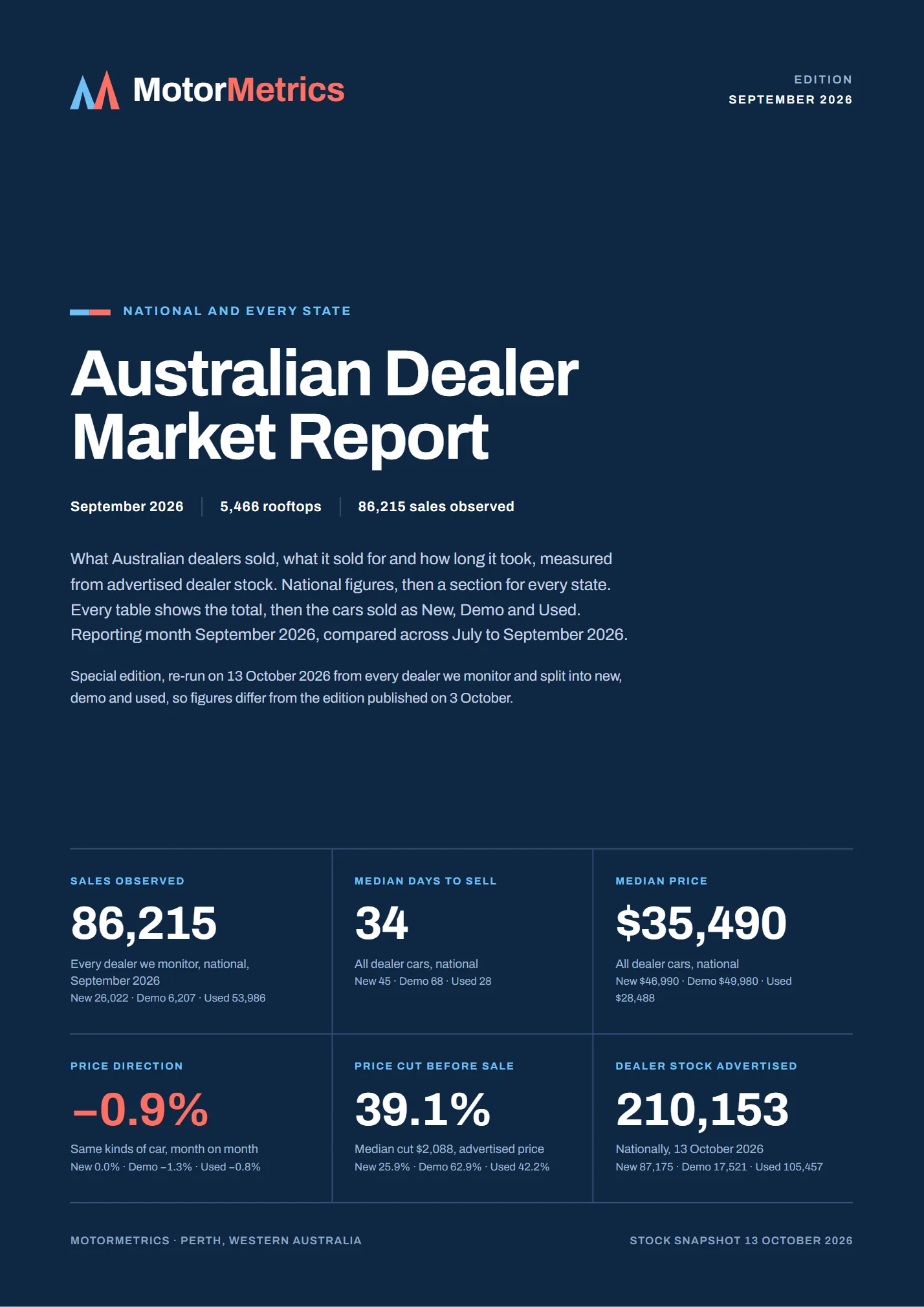
Across 6,828 dealer rooftops, 79,484 sales were observed: 23,189 new, 5,565 demo and 50,730 used. The median car went for $34,107 and took 40 days to sell, against 35 in September. Used cars went for $26,990 and took 32 days. New cars went for $46,405 and took 57. Demo cars went for $49,990 and took 96. From 14 October, days to sell count from the dealer's listing date where the website shows one; earlier sales count from when we first saw the car, which runs shorter.
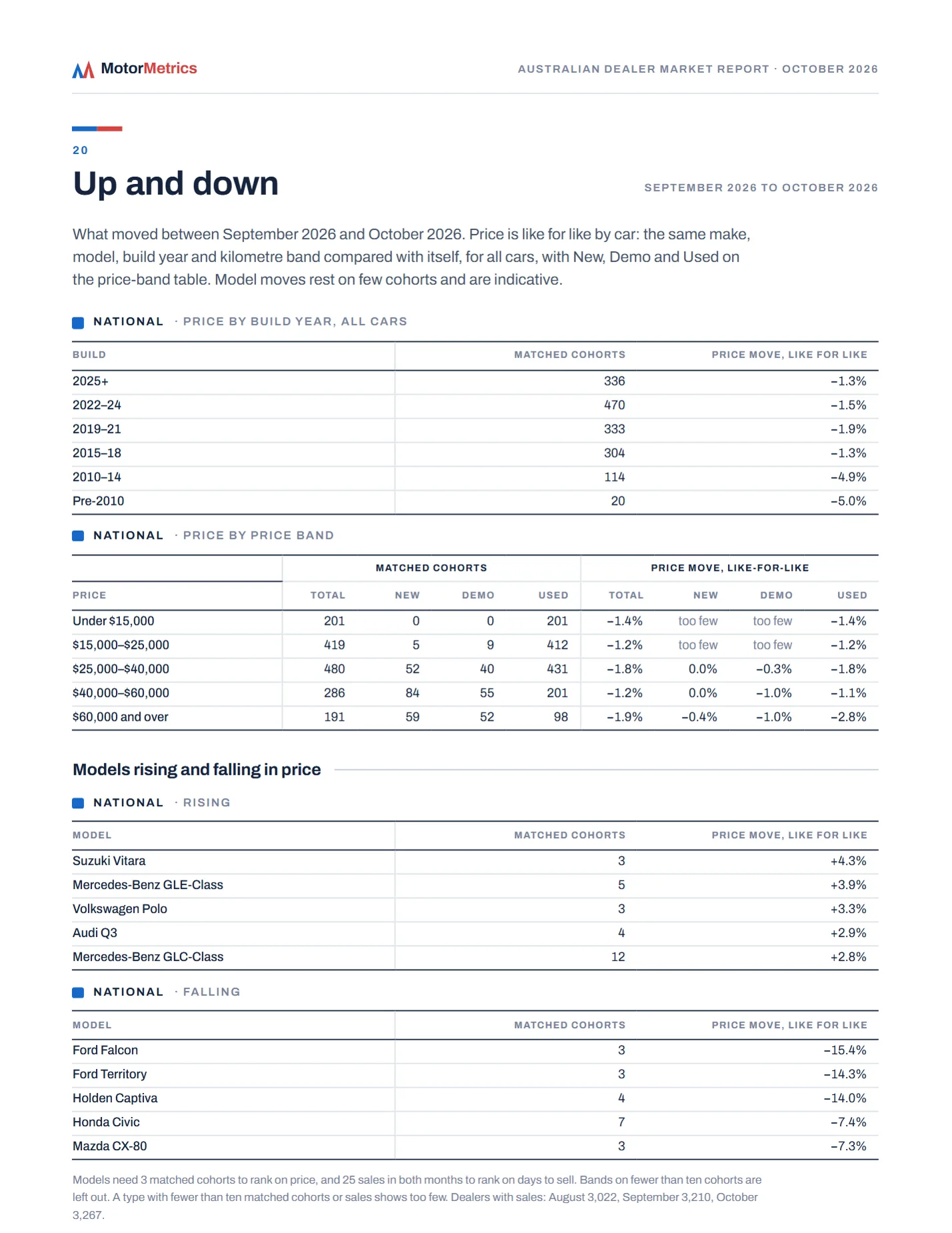
For the same make, model, build year and kilometre band, prices fell 1.6% from September to October. September's fall was 0.7%. New cars held flat, demo cars eased 0.4% and used cars 1.7%.
A note on this edition
Where this note compares October with September, September is measured the same way as October, across every dealer we monitor, so a September figure can differ slightly from the one we published last month.
Discounting
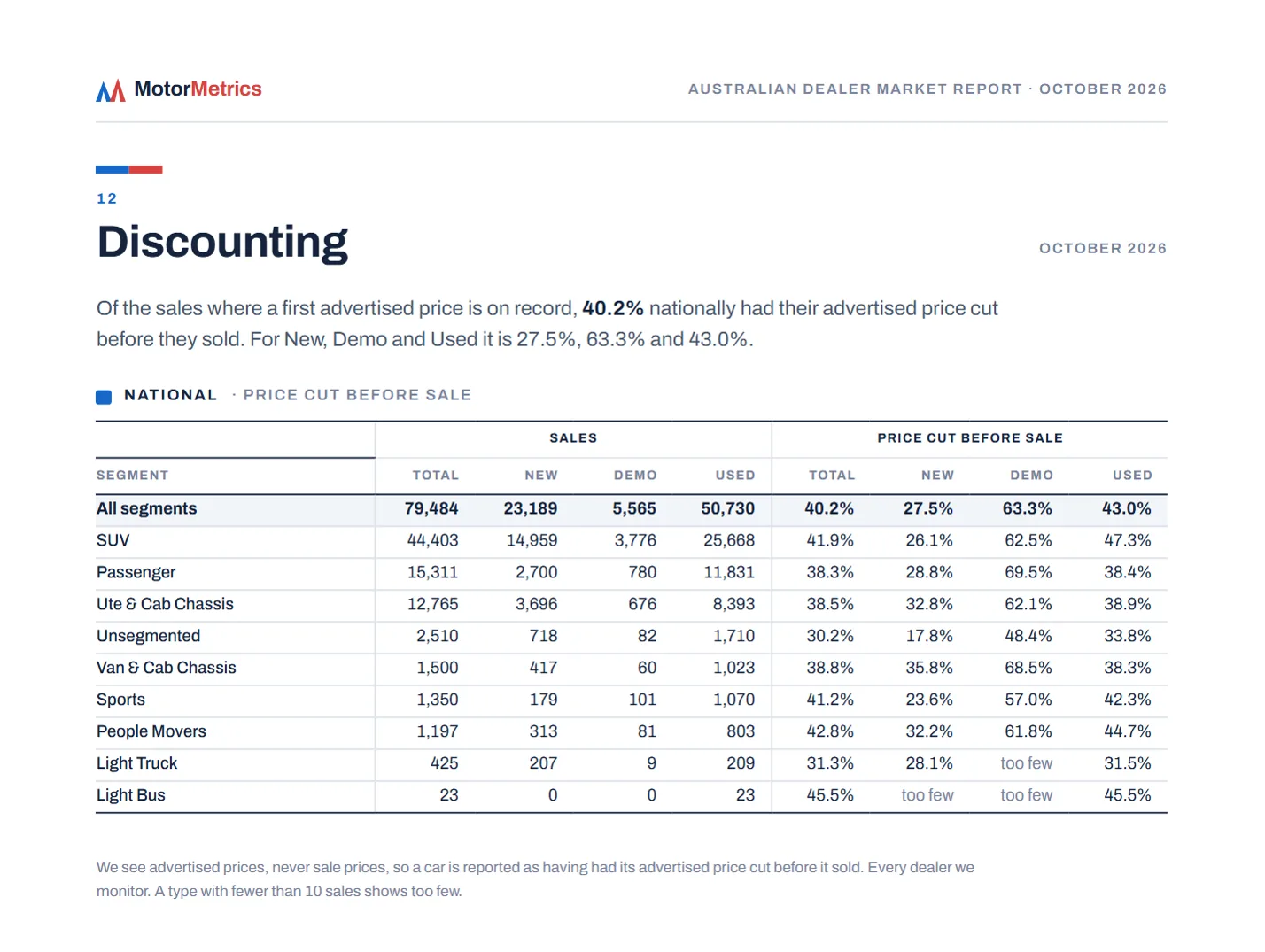
40.2% of cars sold in October had their advertised price cut before they sold, against 39.3% in September. The median cut was $2,000. It varied by type: 27.5% of new cars, 43.0% of used cars and 63.3% of demo cars.
A car that sold without a price cut cleared in a median 23 days. A car that was repriced took 68, nearly three times as long.
Demo cars took longest
Demo cars took 96 days to clear nationally, against 32 for used and 57 for new, at a median $49,990 a unit. They made up 7% of sales.
Fastest and slowest
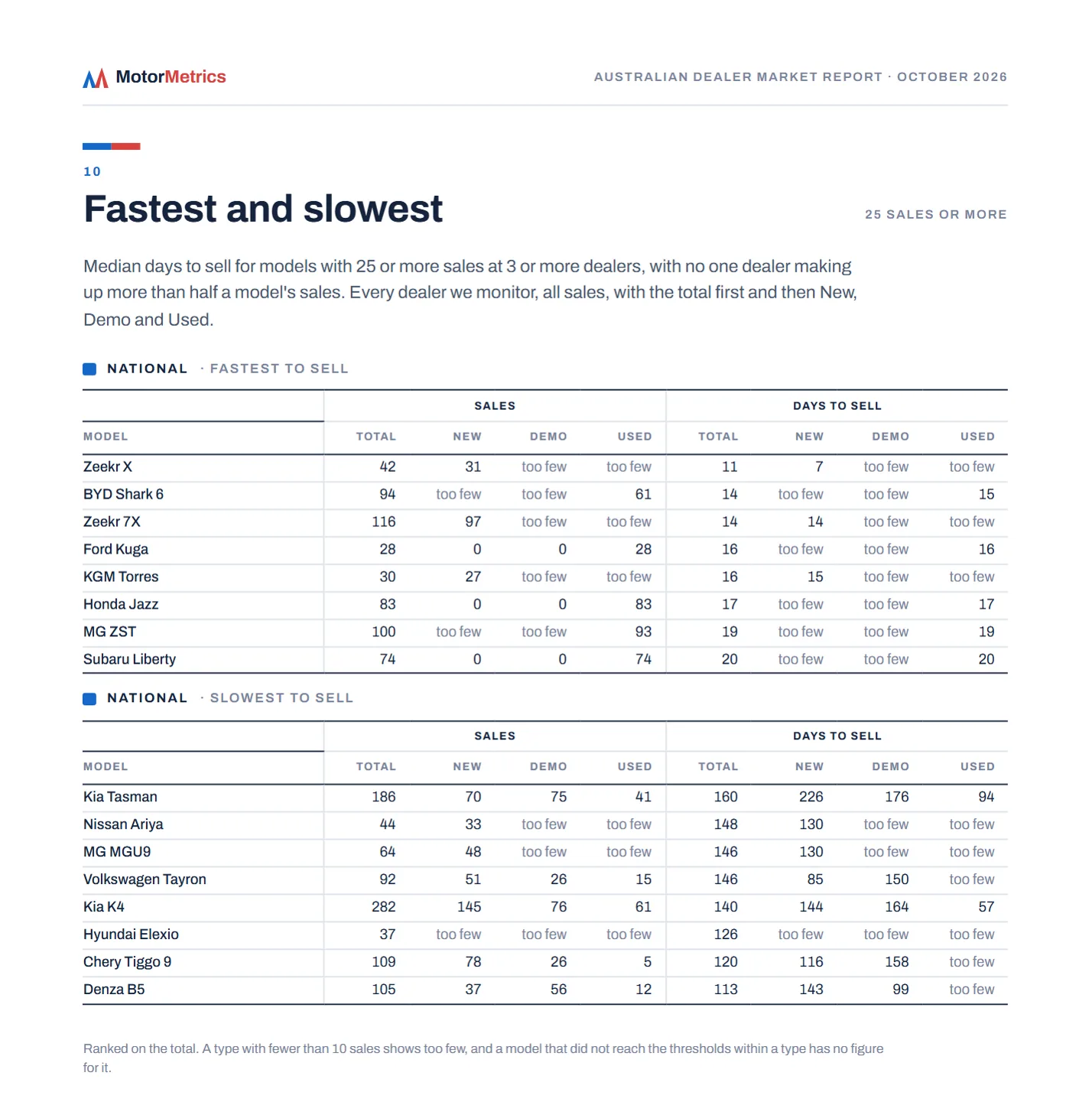
The quickest was the Zeekr X at 11 days. The BYD Shark 6 and Zeekr 7X took 14, the Ford Kuga and KGM Torres 16, and the Honda Jazz 17.
The slowest were new nameplates, mostly new and demo stock. The Kia Tasman sat 160 days across 186 sales, 78% of them new or demo. Nissan Ariya took 148, MG MGU9 and Volkswagen Tayron 146, the Kia K4 140 across 282 sales, and the Hyundai Elexio 126.
Electric share up again
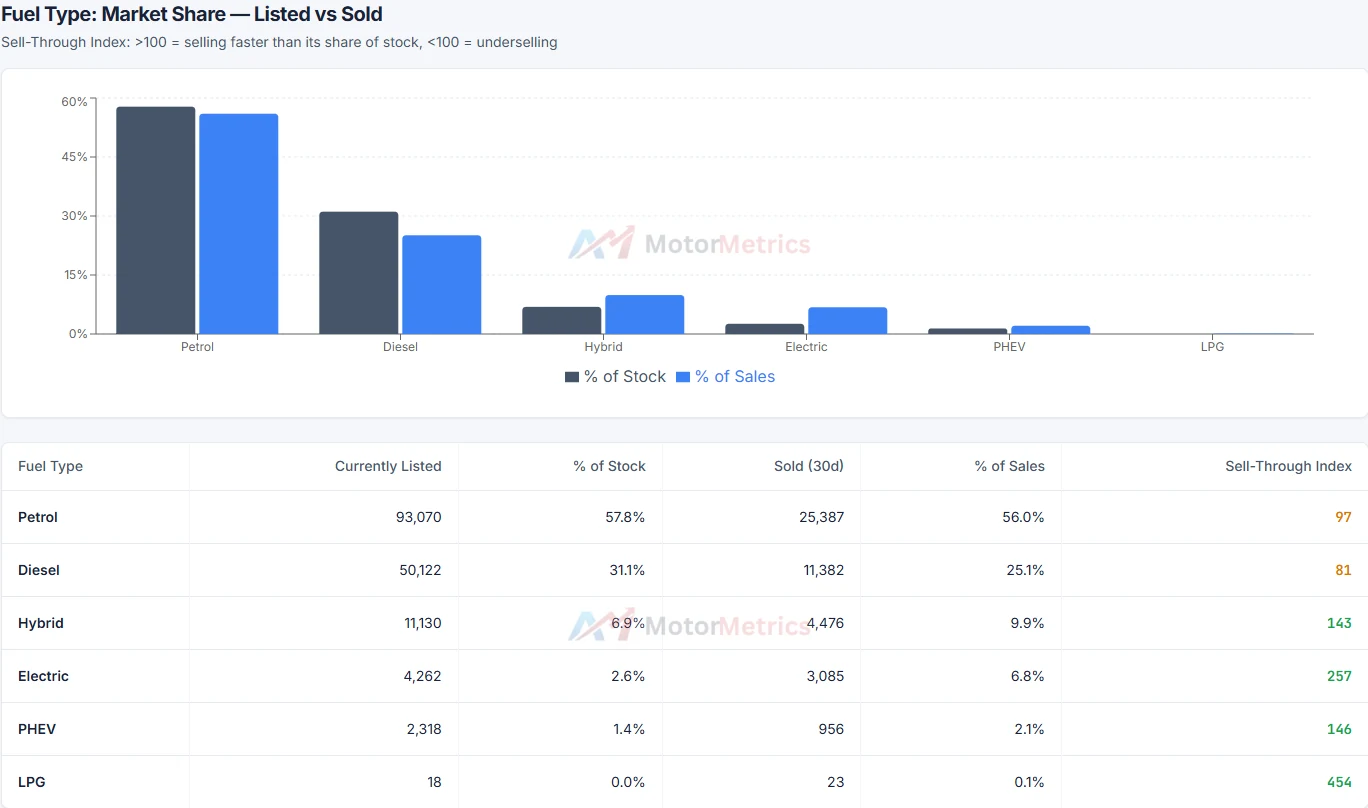
Electric vehicles took 6.8% of sales in October, up from 6.3% in September and 5.1% in August, and sold in a median 42 days. About four in five electric sales were new or demo stock, so that isn't a like-for-like comparison with petrol. Hybrids took another 8.2% and plug-in hybrids 3.2%. Together that's nearly one dealer sale in five.
Makes and models
Toyota held 12.7% of sales, up from 12.1% in September. Mazda took 8.1%, Ford 7.8%, Hyundai 7.6% (down from 8.2%) and Kia 6.6%. The best-selling model was the Ford Ranger with 3,183 sales, then the Toyota Hilux on 1,921, the Toyota RAV4 on 1,745, the Mazda CX-5 on 1,603 and the Mitsubishi Outlander on 1,478. New-car counts cover the stock dealers advertise on their own websites. Toyota dealers list new stock on Toyota-run pages that this edition does not include, so Toyota's New figures are understated.
State by state
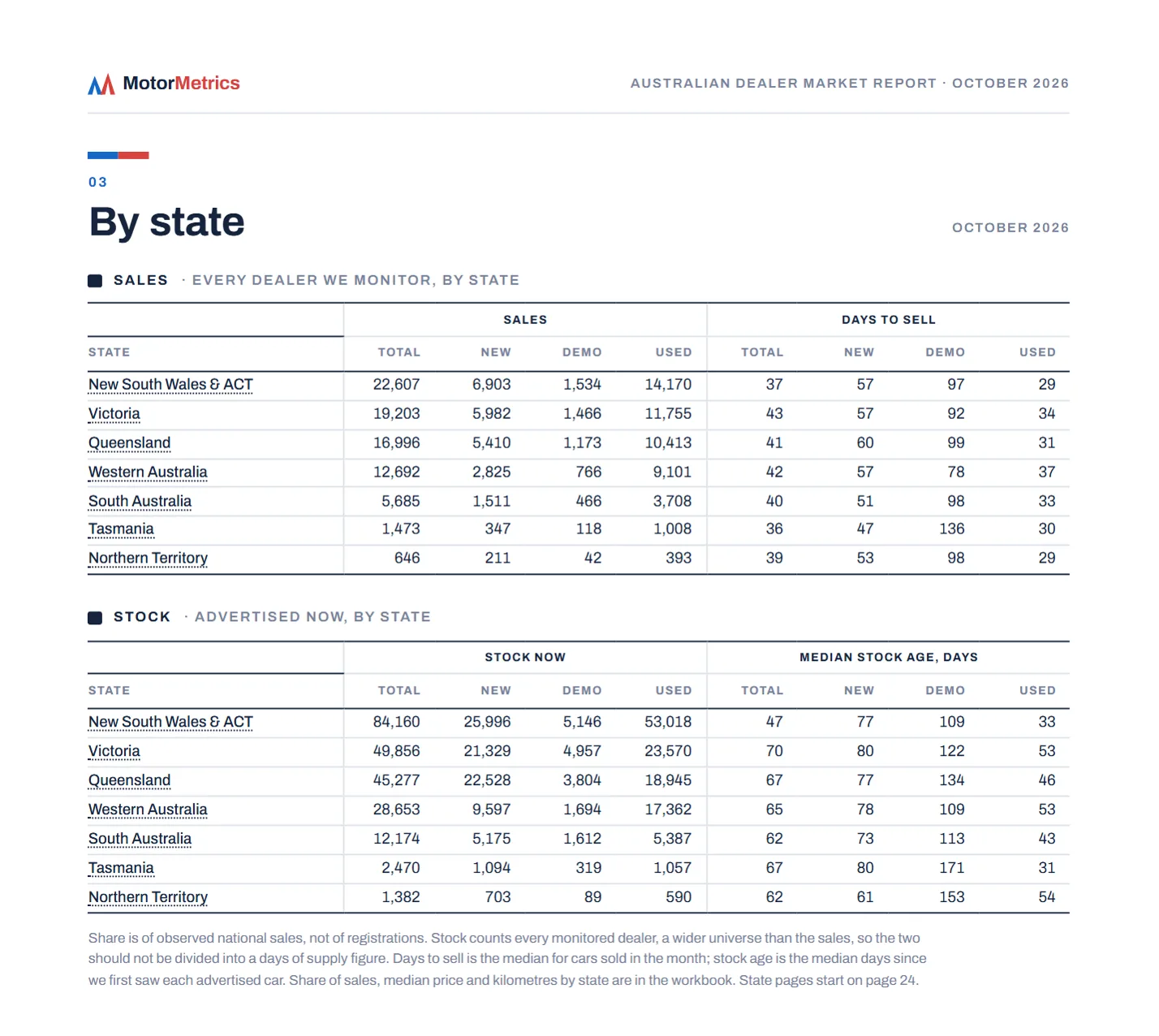
Median days to sell ran from 36 in Tasmania to 43 in Victoria, with New South Wales and the ACT at 37, Queensland at 41 and South Australia at 40. The median car cost most in Victoria ($34,990) and Queensland ($34,980) and least in South Australia ($32,222).
West of the Nullarbor (God's Country)
Western Australia had 12,692 sales at 637 rooftops. The median car cost $33,690 and took 42 days to sell, against 34 in September. Used cars took 37 days and 43.4% of WA sales had their advertised price cut before they sold. For the same kinds of car, prices fell 1.3%.
Perth made up 90.3% of WA sales at a median $32,999 and 42 days. Regional WA made up 9.7% at $36,990 and 39 days. Toyota led with 2,228 sales, then Ford on 1,098, Hyundai 933, Mazda 803 and Mitsubishi 782. The Ranger sold 602, the Hilux 460 and the RAV4 329.
Supply
New listings ran at around 18,300 to 19,200 a week through October, and 224,126 vehicles were advertised across monitored dealers on 1 November, new and demo included. Half of that stock, 50.1%, had been advertised for 60 days or more, counted from when we first saw it. Among the larger segments the share was highest for Large SUVs, at 55.7%.
The takeaway
Prices fell faster than in September, discounting edged up and cars took longer to sell, with the slowdown biggest in new and demo stock. Cars that sold without a price cut went in under a month; cars that were cut took more than two months.
Figures from the Australian Dealer Market Report, October 2026. Advertised stock at Australian dealers, monitored continuously; a withdrawal counts as a sale unless the car is seen advertised again. Medians throughout.