News ·
Is the Fuel Situation Starting to Affect the Used Car Market?
Recent listing price behaviour suggests fuel costs and running expenses may be starting to influence used vehicle pricing, with different fuel types and segments showing different repricing patterns over a short period.
Fuel prices and running costs have become a major topic again in Australia, and while most of the discussion focuses on petrol prices and cost of living, there are early signs that it may also be influencing behaviour in the used car market.
Not through headline price drops or spikes, but through something more subtle: how vehicles are being repriced while they are listed for sale.
Listing Prices Tell an Interesting Story
When a used car is listed for sale, most people assume the price just gradually drops until the car sells. In reality, that's not always how the market behaves.
Dealers regularly adjust prices while a car is listed. Sometimes they reduce prices to move stock, but in other cases they actually increase the advertised price on the same listing.
This usually happens when:
- Competing vehicles sell and supply tightens
- A vehicle was initially listed too cheaply
- New comparable listings enter the market at higher prices
- Dealers adjust pricing based on demand
So instead of a straight line down, the pricing of a listing often moves up and down while the vehicle is on the market.
List → Drop → Hold → Drop → Sell
The used car market is much more dynamic than most people assume.
EV and Hybrid Vehicles Are Behaving Differently
Looking at listing price changes over a short period in March, some EV and hybrid vehicles showed prices holding firm or even increasing while listed, while many older petrol and diesel vehicles were more likely to see gradual price reductions.
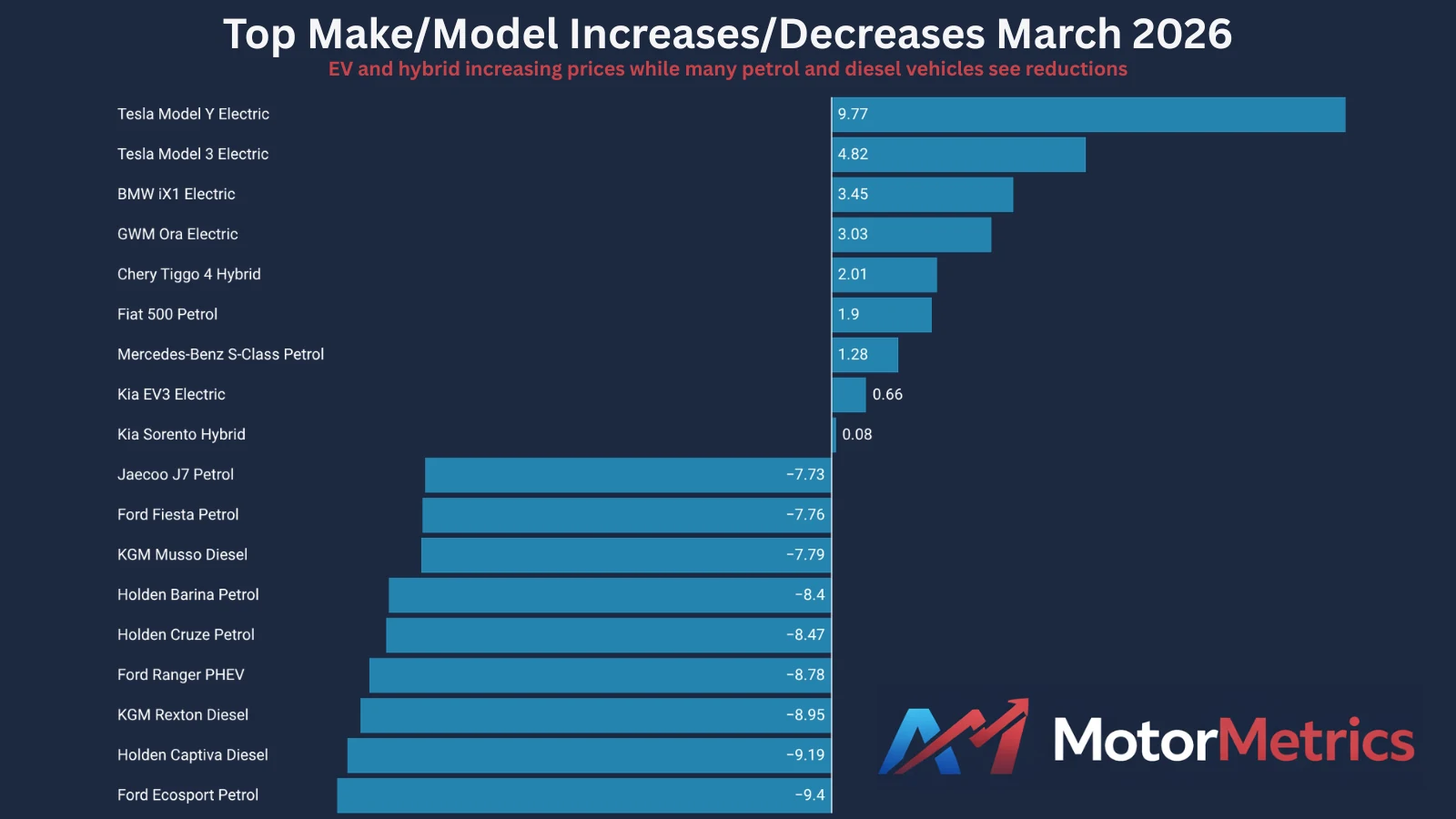
This doesn't prove a long-term shift on its own, but it does suggest that running costs and fuel prices may already be influencing buyer demand and dealer pricing behaviour across different vehicle types.
If fuel becomes more expensive to run a petrol or diesel car, then:
- Demand for fuel-efficient vehicles increases
- Demand for EVs and hybrids increases
- Dealers may not need to discount those vehicles as much
- Higher running cost vehicles may need more discounting to sell
This type of shift would likely show up first in listing price behaviour before it shows up in broader market reports or price indexes.
The Used Car Market Doesn't Move as One
One of the biggest misconceptions about the used car market is that prices all move together. In reality, the market is made up of many smaller segments, and they often move in different directions at the same time.
Fuel costs, running costs and buyer preferences can shift demand between:
- EVs
- Hybrids
- Small fuel-efficient cars
- Large petrol SUVs
- Diesel utes
- Performance vehicles
So instead of the market going "up" or "down", what often actually happens is demand moves from one segment to another.
Early Signs, Not a Conclusion
This is still a short observation window, and it's too early to call this a long-term trend. But listing price behaviour suggests that the fuel situation and running costs may already be starting to influence how different types of vehicles are priced and sold in the used car market.
It will be interesting to see how this develops over the rest of the year.