News ·
August 2026: A market that's moving, just not upward
Dealers sold plenty of cars in August and made slightly less on each. Like-for-like prices slipped 1.3%, and repriced cars took nearly four times as long to sell.
August was a month where Australian dealers sold plenty of cars and made slightly less on each of them.
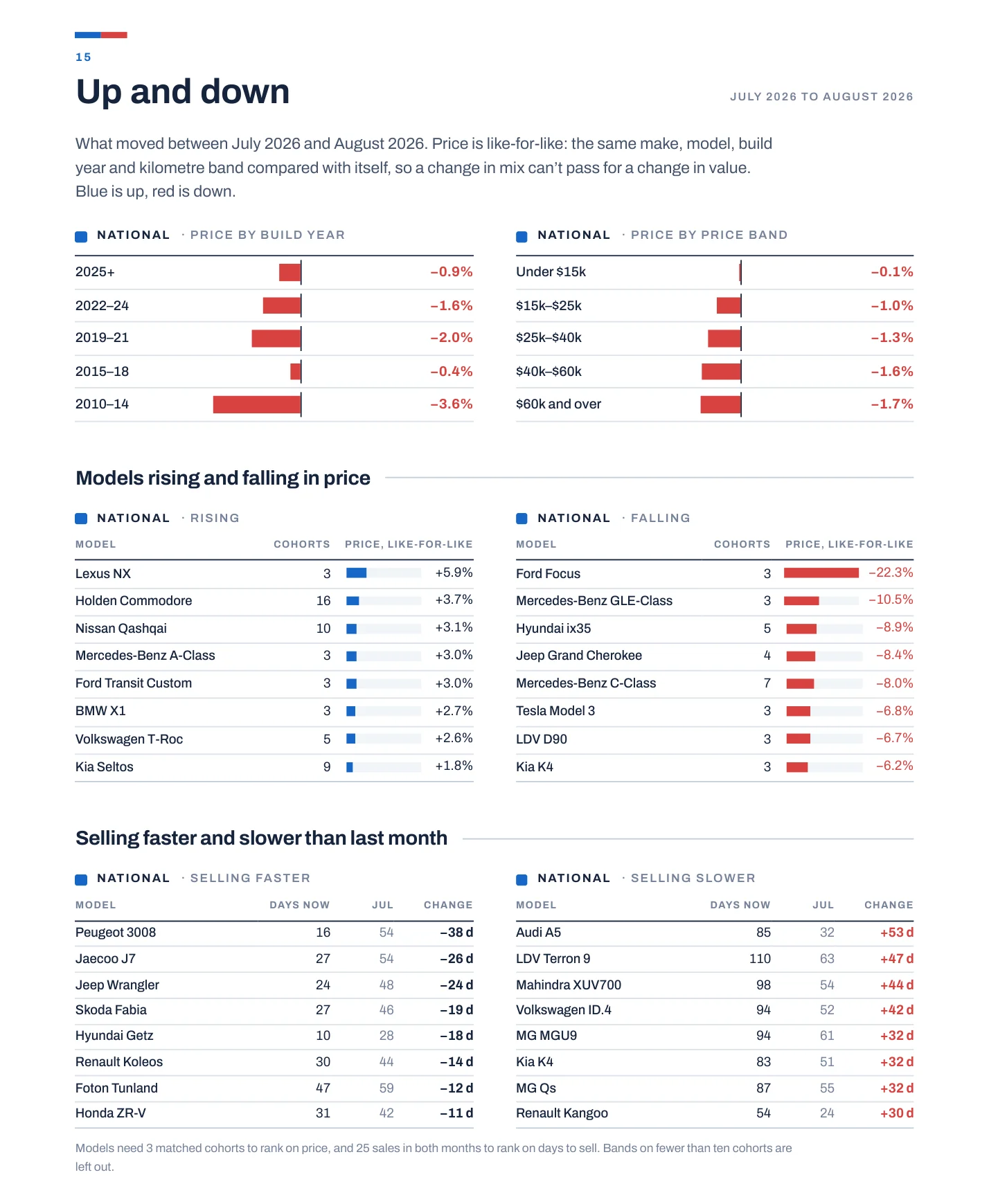
Across 2,679 dealer rooftops monitored daily, 71,168 sales were observed. The median used car went for $29,990, the same as July, but cars took longer to sell, most of it among slower-selling and demo stock. Price direction moved too: like-for-like, the same make, model, build year and kilometre band sold for 1.3% less in August than in July. That's not a collapse. It's the market letting a little air out.
The discount tells the story
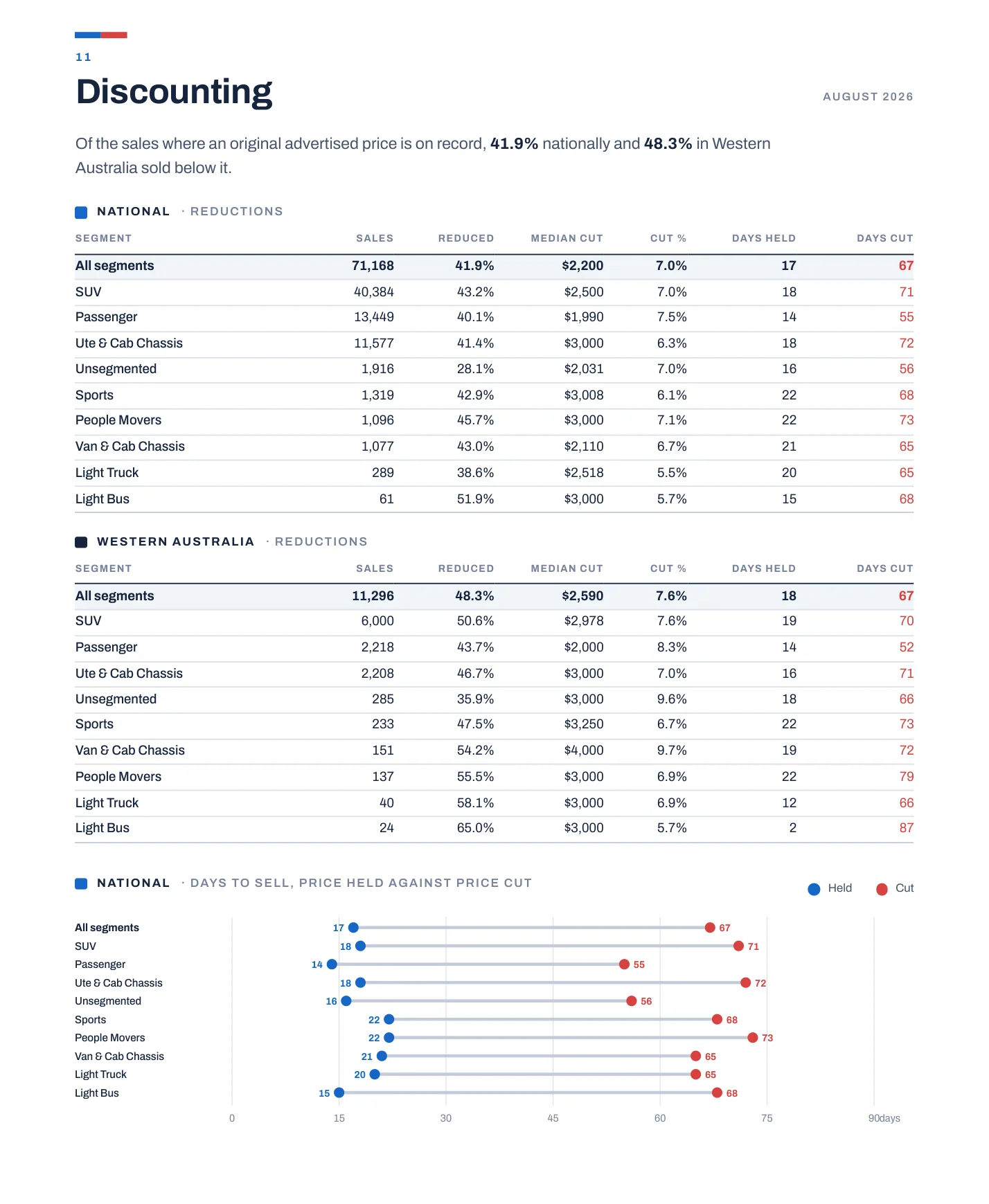
More than four in ten cars sold in August, 41.9%, sold below the price they were first advertised at. The median cut was $2,200, about 7% off the sticker.
But the more useful number is what discounting didn't do. A car that sold at its original price cleared in a median 17 days. A car that had to be repriced took 67. The reduction isn't what sold the car. It's what happened to a car that was never going to sell at the number it was given. Dealers who priced to the market in week one sold nearly four times faster than those who priced to hope and adjusted later.
Near-new is the slow money
Demonstrator and near-new stock took 47 days to clear nationally against 31 for genuine used, at a median $46,888 a unit. That's the most expensive stock on the lot sitting the longest. In a month where new-car supply is plentiful and buyers are price-sensitive, the run-out car is competing with the new one beside it and losing.
What's selling fast, and what isn't
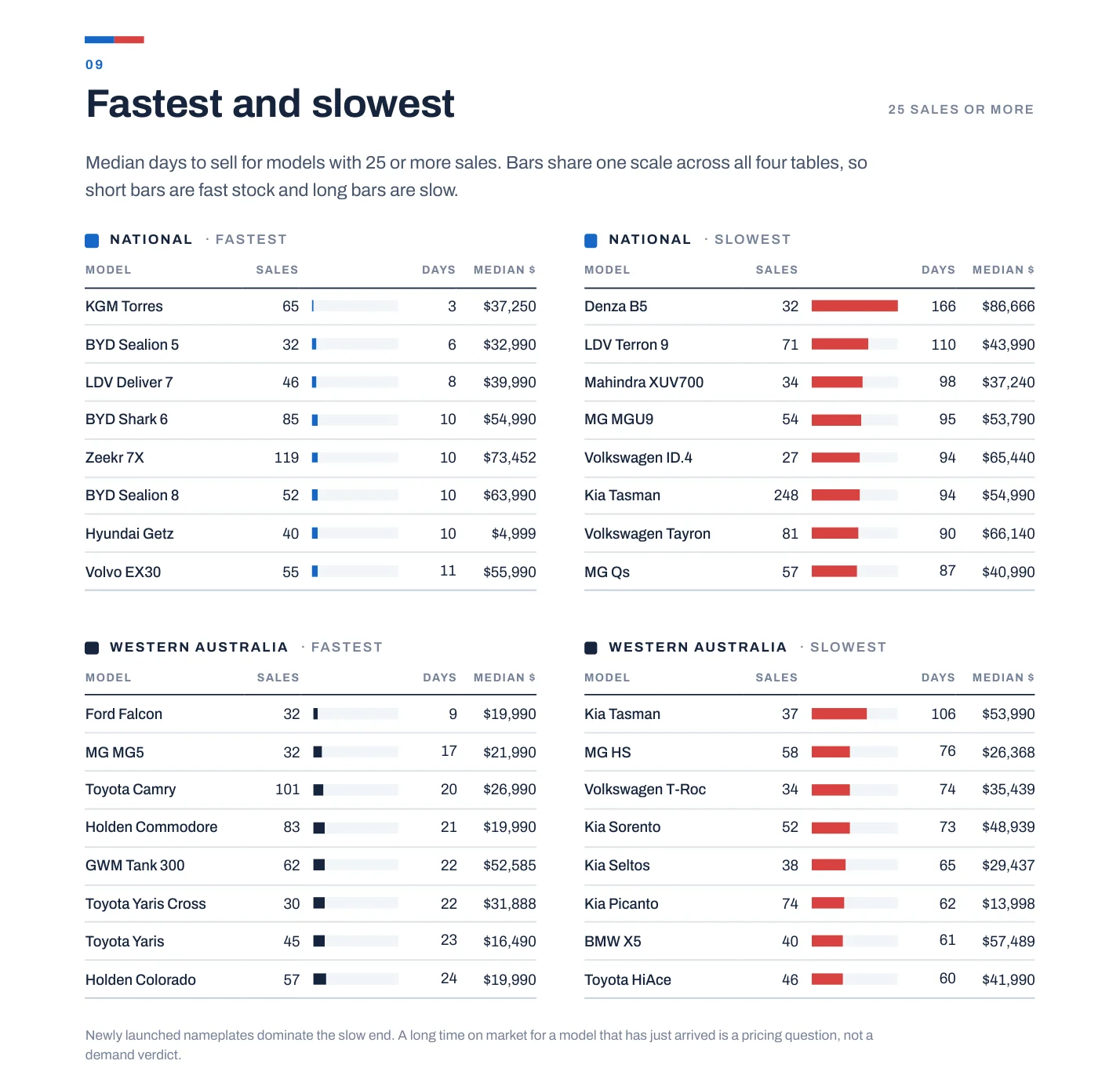
The quickest movers were new nameplates: KGM Torres at 3 days, BYD Sealion 5 at 6, BYD Shark 6 and Zeekr 7X at 10. New product with a warranty is clearing before the paperwork's dry.
The slow end was also new nameplates, just the wrong ones. Denza B5 sat 166 days. LDV Terron 9, 110. Kia Tasman, 94. MG's larger SUVs, 87 to 95. A long time on market for a model that has just arrived is a pricing question, not a demand verdict. Dealers are still learning where these cars sit.
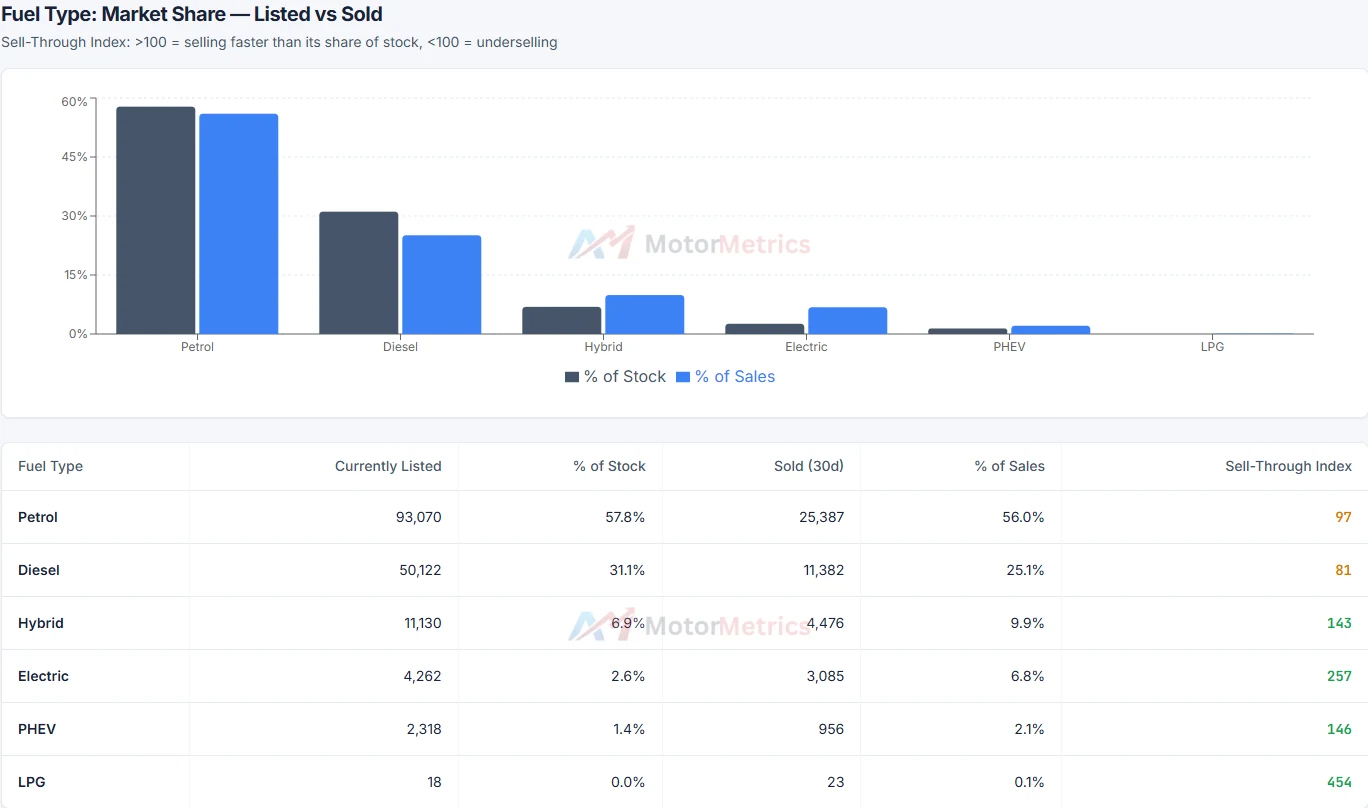
Electric vehicles took 5.0% of sales, up from 3.9% in June, and sold in a median 28 days, faster than petrol at 35 and diesel at 40. The EV is no longer the car nobody wants.
The reliable stuff stayed reliable
Toyota held 12.4% of the market, flat on July. Ranger was the best-selling model at 2,779 sales, and RAV4 and Hilux were the fastest of the big sellers at 24 and 25 days. GWM and BMW gained share, up 0.3 and 0.5 points. Mitsubishi and Subaru each gave back 0.4.
The oldest, cheapest stock moved quickest. Pre-2010 cars cleared in 25 days at a median $8,995. The bottom of the market is the fastest-moving stock there is.
West of the Nullarbor (God's Country)
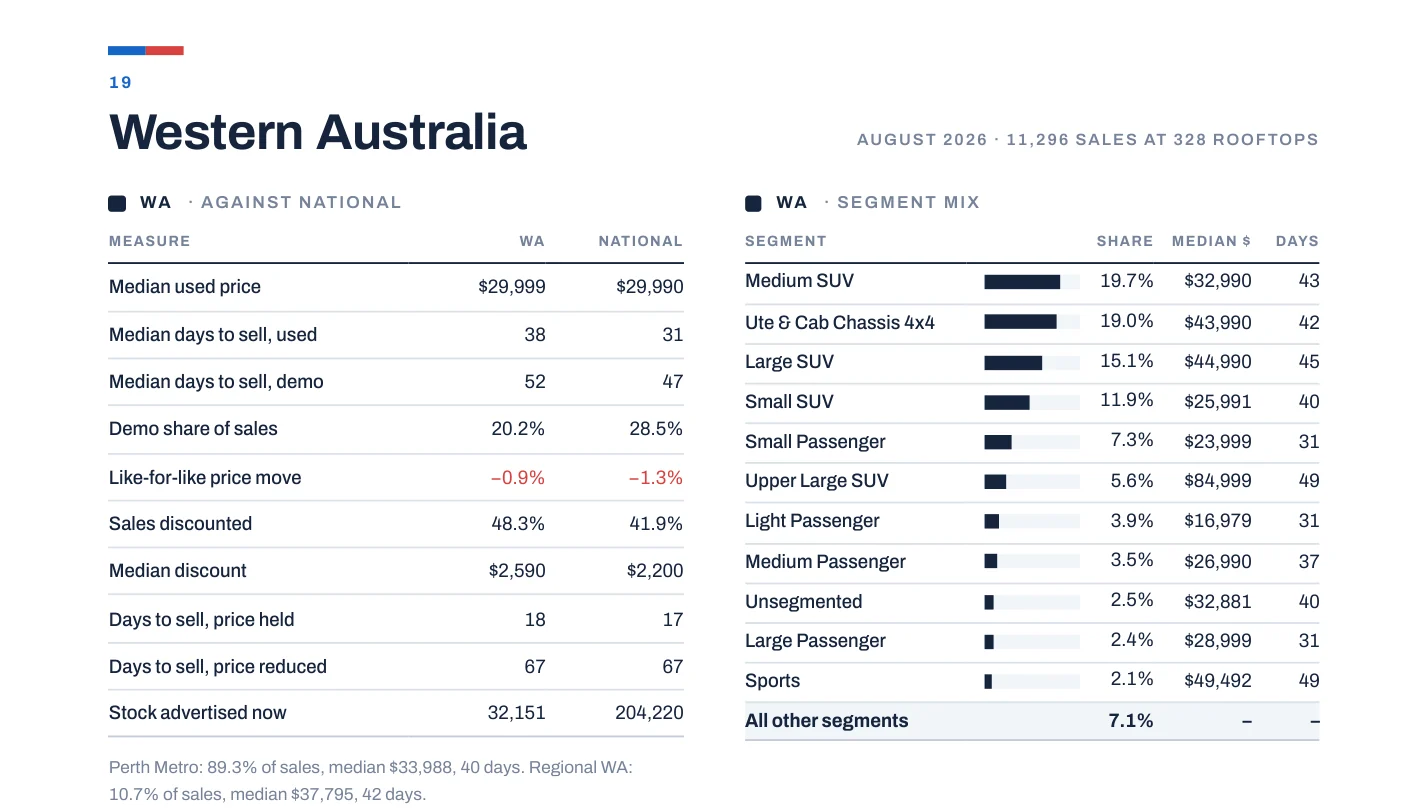
Western Australia discounted harder than the rest of the country, 48.3% of sales against 41.9%, and took longer to sell, 38 days for a used car against 31. WA stock carries more kilometres, a median 56,600 against 36,683 in NSW, and still sold for the same money: a median $29,999 for a used car against $29,990 nationally. Prices held up a little better too, down 0.9% like-for-like against 1.3%.
The fastest-selling car in the state was the Ford Falcon, at 9 days, with the Holden Commodore at 21. Some things don't change.
Supply is steady
New listings ran around 22,000 a week nationally through August, and more than 200,000 vehicles are advertised across monitored dealers. The market isn't short of stock. It's short of stock priced to move.
The takeaway
Volume is fine, and the sticker held. The pressure is on margins and time: cars took longer to sell, and the dealers feeling it least are the ones whose first price was the right one. In a market drifting down a point a month, the cost of waiting for your number is measured in weeks, not dollars.
Figures from the Australian Dealer Market Report, August 2026. Advertised stock at Australian dealers, monitored daily; a sale is recorded when a car is withdrawn from advertising after a period on market. Medians throughout.